06 December 2017

“The things that make me interesting cannot be digitised”: leadership lessons from the Drucker Forum

by Emma Martinho-Truswell

Until recently, I was becoming a conference skeptic. Hours of poorly structured panels, questions that weren’t questions, and mediocre coffee do not make for inspiring conversations or terrific takeaways. But this changed recently. After my essay was shortlisted for the Drucker Challenge, I was invited to attend this year’s Global Peter Drucker Forum, held in Vienna each November. It inspired me, and I wanted to share some lessons from the Forum about how to think about leadership in organisations. Here are three of my favourites.
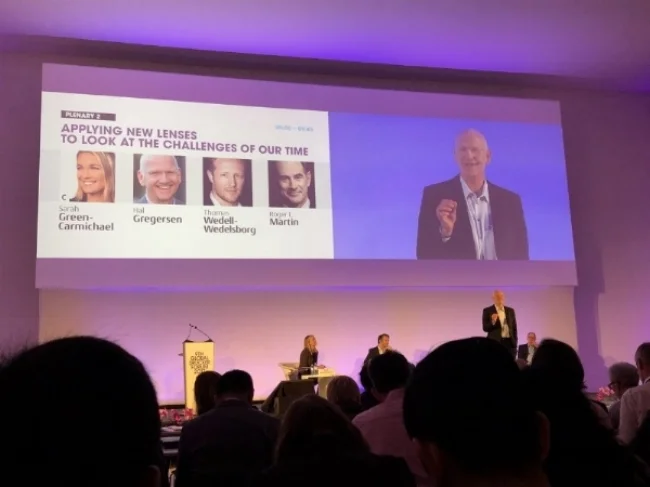
Hal Gregerson at the Forum

Hal Gregerson at the Forum

1. “When was the last time someone in your team asked you an uncomfortable question?”

Hal Gregerson, an authority on leading innovation, asked this question to an audience full of leaders: then told us that if our last uncomfortable question wasn’t recent, we were doing something wrong. Some leaders surround themselves with staff who make the leaders’ life easier but, in turn, make that leader more isolated and less effective. He added that we should also ensure we are regularly in positions where we are quiet (listening to others instead of giving our views) and wrong (corrected by people who are comfortable doing so).

The entreaty to ask leaders to be regularly uncomfortable, quiet, and wrong is a reminder that one of the most important traits a leader needs is courage. While plenty of leaders are happy being quiet, few enjoy being uncomfortable or wrong. This means not only accepting correction or questioning, but actively seeking it out, wading through awkwardness on both sides, taking criticism and using it to get better. I’ve been trying out questions with my team to make this easier for them: “what should I do differently next week?”, “what is the company doing that worries you?”, “do you have any feedback for us?”.

Charles Handy at the Global Peter Drucker Forum 2017

Charles Handy at the Global Peter Drucker Forum 2017

2. “The things that make me interesting cannot be digitised”

A strong theme throughout the conference was the role of technology in our lives and our organisations, and in particular, its excesses. This was a concern across disciplines: leadership and management, social anthropology and economic history.  Speakers including Julia KirbyRahaf FarhoushDon Tapscott and Carlota Perez each spoke on this theme. They warned that technology has not given us the promised connectedness but, instead, has increased isolation and exploitation. I think Charles Handy summed it up best in his final address when he talked about his own humanity and said that, at his best, he has hopes and dreams and imagination: “the things that make me interesting cannot be digitised”.

The Saturday after the conference, the New York Times published a piece with a similar theme: David Sax writing “Our Love Affair With Digital Is Over”.

It’s a compelling headline, but I don’t think it’s quite as simple as that. Some of our hopes for digital are disappointed, but we continue to live huge parts of our work and social and creative lives online and, increasingly, on smartphones. The question for leaders is how to reconcile technology as it is with human desires for connection and for belonging. Some tools are better than this at others; and no technology will ever be as good as making time for face-to-face.

I increasingly think that the best thing technology can offer us is more face-to-face time: rescuing us from drudgery, from administration, and from the least creative work. To me, this is about seeing new technologies such as artificial intelligence as similar to the dishwasher or the vacuum cleaner, saving time for things that are more precious. If this is right, it means that individuals and organisations have a big responsibility to find ways to make sure that any time freed up is used well (and not just on our smartphones).

The Hall of Sciences, the venue of the Global Peter Drucker Forum 2017

The Hall of Sciences, the venue of the Global Peter Drucker Forum 2017

3. “Business is an inherently compassionate enterprise”

This was a quote was from Chris Maclay, Head of Growth at Lynk Kenya, inspired by the idea that businesses exist to solve a problem for people. Chris was a prize-winning essay writer attending as part of the Drucker Challenge (the competition that also brought me to Vienna), and his company helps workers in Kenya to find jobs more easily. This was a theme echoed by Ali Rushdan Tariq, a Drucker Challenge winner, who argued in his essay that the best source of competitive advantage for a modern company is compassion – for its employees, its community and its society.

I believe a good business is a compassionate business. (This is so much more than just business: I think good organisations are compassionate organisations, because principles like these extend to governments, to NGOs, and to international organisations, none of which should take compassion for granted.)

Tammy Erickson commented that organisations should be very clear on what they offer employees, then meet those expectations. The expectations should be simple: for Exxon Mobil, for example, it is being ‘safe and ethical’. Compassionate organisations can show their values in a variety of ways: by paying their employees properly (avoiding unfair practices like unpaid internships), by helping their teams work on projects they feel passionate about, and for showing they care about employees as people at times when they need extra support. For us at Oxford Insights, the decision to pay ourselves last (and, to begin with, less than our interns) was about helping to form and then live up to compassionate values.

At a time when machines are getting better at many of the things humans do well, a compassionate organisation reminds us of the things humans do best.

Insights

More insights

21 April 2017

Why Government is ready for AI

12 July 2017

Five levels of AI in public service

26 July 2017

Making it personal: civil service and morality

10 August 2017

AI: Is a robot assistant going to steal your job?

19 September 2017

AI and legitimacy: government in the age of the machine

06 October 2017

More Than The Trees Are Worth? Intangibles, Decision-Making, and the Meares Island Logging Conflict

16 October 2017

The UK Government’s AI review: what’s missing?

23 October 2017

Why unconference? #Reimagine2017

03 November 2017

AI: the ultimate intern

09 November 2017

Motherboard knows best?

23 November 2017

Beyond driverless cars: our take on the UK’s Autumn Budget 2017

05 December 2017

Why Black people don’t start businesses (and how more inclusive innovation could make a difference)

23 January 2018

Want to get serious about artificial intelligence? You’ll need an AI strategy

15 February 2018

Economic disruption and runaway AI: what can governments do?

26 April 2018

Ranking governments on AI – it’s time to act

08 May 2018

AI in the UK: are we ‘ready, willing and able’?

24 May 2018

Mexico leads Latin America as one of the first ten countries in the world to launch an artificial intelligence strategy

05 July 2018

Beyond borders: talking at TEDxLondon

13 July 2018

Is the UK ready, willing and able for AI? The Government responds to the Lords’ report

17 July 2018

Suspending or shaping the AI policy frontier: has Germany become part of the AI strategy fallacy?

27 July 2018

From open data to artificial intelligence: the next frontier in anti-corruption

01 August 2018

Why every city needs to take action on AI

09 August 2018

When good intentions go bad: the role of technology in terrorist content online

26 September 2018

Actions speak louder than words: the role of technology in combating terrorist content online

08 February 2019

More than STEM: how teaching human specialties will help prepare kids for AI

02 May 2019

Should we be scared of artificial intelligence?

04 June 2019

Ethics and AI: a crash course

25 July 2019

Dear Boris

01 August 2019

AI: more than human?

06 August 2019

Towards Synthetic Reality: When DeepFakes meet AR/VR

19 September 2019

Predictive Analytics, Public Services and Poverty

10 January 2020

To tackle regional inequality, AI strategies need to go local

20 April 2020

Workshops in an age of COVID and lockdown

10 September 2020

Will automation accelerate what coronavirus started?

10 September 2020

Promoting gender equality and social inclusion through public procurement

21 September 2020

The Social Dilemma: A failed attempt to land a punch on Big Tech

20 October 2020

Data and Power: AI and Development in the Global South

23 December 2020

The ‘Creepiness Test’: When should we worry that AI is making decisions for us?

13 June 2022

Data promises to support climate action. Is it a double-edged sword?

30 September 2022

Towards a human-centred vision for public services: Human-Centred Public Services Index

06 October 2022

Why You Should Know and Care About Algorithmic Transparency

26 October 2022

Harnessing data for the public good: What can governments do?

09 December 2022

Behind the scenes of the Government AI Readiness Index

06 February 2023

Reflections on the Intel® AI for Youth Program

01 May 2023

Canada’s AI Policy: Leading the way in ethics, innovation, and talent

15 May 2023

Day in the life series: Giulia, Consultant

15 May 2023

Day in the life series: Emma, Consultant

17 May 2023

Day in the life series: Kirsty, Head of Programmes

18 May 2023

Day in the life series: Sully, Partnerships Associate/Consultant

19 May 2023

LLMs in Government: Brainstorming Applications

23 May 2023

Bahrain: Becoming a regional R&D Hub

30 May 2023

Driving AI adoption in the public sector: Uruguay’s efforts on capacity-building, trust, and AI ethics

07 June 2023

Jordan’s AI policy journey: Bridging vision and implementation

12 June 2023

Response to the UK’s Global Summit on AI Safety

20 June 2023

 Unlocking the economic potential of AI: Tajikistan’s plans to become more AI-ready

11 July 2023

Government transparency and anti-corruption standards: Reflections from the EITI Global Conference in Dakar, Senegal

31 August 2023

What is quantum technology and why should policymakers care about it?

21 September 2023

Practical tools for designers in government looking to avoid ethical AI nightmares

23 October 2023

Collective Intelligence: exploring ‘wicked problems’ in National Security

23 October 2023

Exploring the concepts of digital twin, digital shadow, and digital model

30 October 2023

How to hire privileged white men

09 November 2023

Inclusive consensus building: Reflections from day 4 of AI Fringe

13 November 2023

AI for Climate Change: Can AI help us improve our home’s energy efficiency?

14 November 2023

Navigating the AI summit boom: Initial reflections

20 November 2023

AI for Climate Change: Improving home energy efficiency by retrofitting

24 November 2023

Will AI kill us all?

27 November 2023

AI for Climate Change: Preventing and predicting wildfires 

28 November 2023

Service Design in Government 2023: conference reflections

04 December 2023

AI for Climate Change: Using artificial and indigenous Intelligence to fight climate change

06 December 2023

Release: 2023 Government AI Readiness Index reveals which governments are most prepared to use AI

11 December 2023

AI for Climate Change: AI for flood adaptation plans and disaster relief

18 December 2023

AI for Climate Change: Managing floods using AI Early Warning Systems

28 May 2024

Strengthening AI Governance in Chile: GobLab UAI and the Importance of Collaboration

05 June 2024

Towards a Digital Society: Trinidad and Tobago’s AI Ambitions

17 June 2024

General election 2024 manifestos: the AI, data and digital TLDR

26 June 2024

Building Egypt’s AI Future: Capacity-Building, Compute Infrastructure, and Domestic LLMs

16 July 2024

Beyond the hype: thoughts on digital, data, and AI and the first 100 days

30 July 2024

AI for a brave new world

07 August 2024

Beyond Central Government: How ANIA is shaping Mexico’s AI Landscape

30 October 2024

How AI could support the government’s anti-corruption agenda

06 December 2024

Harnessing AI for development: Uzbekistan’s progress towards becoming a regional IT hub

15 January 2025

Tracking Progress on the UK’s AI Opportunities Action Plan: Implementation is what counts for growth

25 February 2025

The state and vision of the UK digital government

12 March 2025

Beyond Open Data: The Critical Role of Government in Data Sharing

01 April 2025

From policy to practice: how ALIA strengthens Spain’s public AI infrastructure

03 April 2025

Systemic AI risk is slipping off the international agenda. Should we care?

23 April 2025

The Overlooked Importance of Data Reuse in AI Infrastructure

30 April 2025

Why I am excited about the Performance Review of Digital Spend

19 May 2025

How Datanomix.pro is using AI to fight fraud and misconduct in Kazakhstan

22 May 2025

Education at the centre stage: Georgia’s bottom-up approach to building national AI capacity

12 June 2025

‘Cutting back office costs’ – AI in the Spending Review

10 July 2025

La transformation digitale au Maroc : le rôle stratégique de la méthode agile

10 July 2025

Digital transformation in Morocco: the strategic role of the agile method

29 January 2026

Beyond the Hype: The Reality of Being a Consultant at Oxford Insights

04 February 2026

Joining Oxford Insights: People at the Heart of Global Transformation

17 February 2026

Bringing solutions from AI startups to the government – The case of the ASAN AI Hub in Azerbaijan

02 March 2026

AI in France: betting on AI adoption and sovereignty rather than racing for the most powerful models

02 March 2026

IA en France: miser sur la souveraineté et les services plutôt que sur la course à la puissance des modèles

11 March 2026

Innovation under tough circumstances: Ukraine’s AI strategy in times of war

29 April 2026

Использование стандартов данных в экологическом мониторинге: выводы на основе опыта Центральной Азии

29 April 2026

Using data standards to build resilience in a warming world: lessons from environmental monitoring in Central Asia

01 May 2026

Is this useful? Effective Service Delivery in the UK

08 May 2026

Turning concepts into reality: how business analysts make it possible

13 May 2026

Value-based NHS procurement: why peer networks matter more than expert ratings

15 May 2026

Stewarding the “OI Way”: why we’re hiring a Director of Delivery

20 May 2026

Sovereign AI is the wrong framing

03 June 2026

From vision to reality: five lessons from advising governments on AI

12 June 2026

El Papa, el Presidente y el G7: qué significa la disputa por el poder en la gobernanza de la IA para los países intermedios

12 June 2026

The Pope, the President, and the G7: what the AI governance power contest means for middle states

30 June 2026

Why diverse thinking makes for better public-sector delivery, and what that means for how we hire

08 July 2026

Embracing scepticism, earning trust: lessons from Sport England’s Data & AI Lab

15 July 2026

There is no side to take on frontier AI

27 July 2026

Europe’s AI Advantage is Not Compute

04 August 2026

Why we are inviting governments to submit evidence to the Government AI Readiness Index